Tuesday, June 03, 2025

Grades are just numbers

It's the end of the semester, and I have put up students' grades online. They actually get to know their progress weekly, as I grade their assignments after every submission. 

And then the texts came in. Asking for better grades, asking for an A. Wanting to graduate cum laude.

Not one, not two.. 

Banyak.

As a flunking student throughout much of my young adolescence, my first reaction was "Ga pentinggggggg whyyyyyy". IPk-ku pertama itu 2.17 and the world did not end. 

I understand job competition was much less intense in the early 2000s, and things like grades have historically different consequences to students' future compared to post-pandemic times. 

But on a human level... I hope what you feel and learn in class and beyond matters much more than numbers on a piece of paper. I hope your self-worth is not determined by pieces of papers. 

Much love.

Wednesday, May 21, 2025

Bizarro world

In the past months, some of my students and early career colleagues told me they read my blog (which I have not updated in such a long time). 

So weird. 

Since I don't know what to make of it, I suppose I'll write about it. And before writing, I usually ask what they thought when reading such random rambles. 

Indira (not real name) said her friend reads this blog in silent as a PhD student caring for a young child. It made her feel less alone. She also said that she got to know me when I have figured out who I was and what I wanted to do for a living, and wished she could ask in my 20s and 30s, what the hell happened. 

HELL HAPPENED. HAHHAHAHAHAHHAA. 

Rasanya eek banget lah jadi young adult (and an adult too actually HUAHAHAHA), ga tau kerja apa, ga tau mau jadi apa, pingin tidur aja seharian semalaman nonton TV main game, dimarahin adults....... (Yha~.. Jaxelku keluar....) Feeling inadequate, stubborn, pingin lari, tapi pingin juga lari ke sesuatu... Baru sampe rumah, ada "MAMAAAAAAAA" dikintilin ke kamar mandi. Nangis aja ga ada tenaga LOLOLOLOLOL.

All these feelings are normal. I too feel it once in a while, still. And it's ok. Puk puk, brush yourself off, get back on your feet, and try again. Even if trying again means crying with your kid saying, "I am so tired. Shall we be tired together for 30 minutes?". 

So.. I am around. Drop messages and questions, I'll try to be as honest and as open as I can. We'll figure out how all my pain and lessons learnt (or unresolvable traumatic experiences) can be of use to you (and me).

Enak juga nulis freestyle, ga pake banyak mikir cos I have been writing academically and professionally within such structured corridors. So it's good that some of you reached out to make me write freely again. Feeling useful goes both ways. In reciprocity, and in solidarity. 

Hugggggggsssss.......

Monday, July 19, 2021

Badge of Honour

It’s been some time since I posted anything. What with COVID-19 and everything that has left us with even more disorientation than the ordinary...

I am on my 12th year teaching now, and the age gap between my 18 year old students and I is growing wider. Quite factually.

Every year, my new students ask if I knew what I wanted to do for a living since I was their age (18 yo)?

Every year, my last year students ask if I am happy with my job.

The answer to both, is no.

I was clueless and lost when I was 18, and I didn’t know what I wanted to do when I was 21. I fit nowhere.

And we will always fit nowhere, if what we seek is a semblance of social bonds in our labouring.

The economy is structured in such a way that any human being, doing what they do best in the happiest point they are, will not be paid or is paid poorly. It is called capitalism. It will reap you for all you are worth, and them some, and ruin any meaningful relationship you have with your loved ones. It’s just how it’s been operating in the past three centuries. We are minuscule compared to how complex and advance it’s structured.

All we have, are those fleeting moments when we can see the best us in our social relationships. It can be in music, poems, film, a lab experiment, a garden... When we labour, we can realise the most worthy part of us in our social relationships. And I—becomes us.

If this is what you relate to, you won’t be paid much by the capitalist economy. You would have to let go of your aspirations for upward mobility, and the social acknowledgements that come with it. You would have to accept social stigmas. “Failure”, “outcasts”, “a shame”. You would need to grow a thicker skin.

But I promise you, if you can feel self-empathy in ways that are in line with your social empathy, other options seem unnecessary. Being a social outcast, slowly, becomes a badge of honour.

Know that you are not alone in feeling that way. In a dog-eat-dog social world, not being successful might mean you never had the heart to step on someone else’s to toes to get ahead. And you begin to see those who can, in a very different way.

Sunday, September 20, 2020

100 words


This post was written as part of the “Foundations to Writing” Class; and if I cannot do what I teach, I do neither.  


I am a 38 year old mother of one, whose sense of self is less and less shaped by expectations—be it from myself or other people. Decades of mistakes and messiness have allowed me the space to be comfortable in my own skin, with all the scars and blemishes. 


Increasingly, it is much easier to carry myself as I am, rather than cover some parts and announce others. I am myself wherever I am. On the toilet, in class, and in an any time span!

Friday, October 11, 2019

On Being Alone Together

Research has shown that there is an increase in loneliness in the 21st century. This systemic problem is the socio-psychological effect of rapid industrialisation and urbanisation which has shaped hyper-competitive individuals. However, human beings, as most mammals, are social beings. We are evolutionarily ingrained to live socially while our society, in the past two centuries, has developed in a way that forces us to live individually.

This is why, I think, any study regarding social media and loneliness need to place it within broader social changes in post-Fordist societies. It is less about social media’s effect in individualising human behaviour, than it is about social media exacerbating an already economically-driven social disconnect between neighbours, co-workers, and family members. It is a fact that must be accepted as our social reality before any serious try to find an antidote. Perhaps, it can only come in the form of a simple “hello” to the stranger next to us on the train.

-->

Friday, September 27, 2019

A Call for the Politics of Redistribution

As part of this week's Foundations to Writing Class that I am teaching, I'd like to talk about politics and young people in a digital world by taking the case of Indonesia.

After Indonesia's Reformasi, the largest demonstration took place at capital city Jakarta on 2 December 2016. The mass movement, in which young people comprise of most of the participants, was coined as the 212 rally; directed to demand the trial of then governor Basuki Tjahja Purnama for blaspheming against Islam. It was the most massive religiously-driven mobilisation in the history of the heterogeneous, secular country, which is also the fourth largest democracy in the world.

Studies have shown that while Islamic politics featured prominently in the demonstration, it was grievances over social and economic inequality felt among large sections of the lower and middle classes that drove them to be part of the Action to Defend Islam--#aksibelaIslam. Islamic morality provided a cultural resource pool for both the political elites to mobilise during elections, as well as bind together an otherwise fragmented lower and middle class ummah. In these process of mobilisation, the role of social media was prominent. Multiple platforms were used by campaigners to inflame demonstrators.

It is with that in mind that I'd like to approach the student-led demonstration on 22 May 2019, and I'd like to begin with this excellent article at Coconuts.

Source: Coconuts.

The demonstration occurred in multiple cities across Indonesia, with an estimated 10,000 in Jakarta alone. Global media portray students as having a historical role in Reformasi, and that it is reminiscent of the 1998 student protest demanding then president Suharto to step down. Political analysts have argued that in 2019, a huge driver was the weakening of the Corruption Eradication Commission and criminal codes pervading the private lives of citizens, happening under president Joko Widodo's administration previously seen as an alternative to New Order elites.

While the binding agenda at the student rally demand constitutional rights that are non-discriminatory, which is starkly different from the Action to Defend Islam rally, a fundamentally common narrative is discontent towards the current political elites. Social media hashtags #ReformasiDikorupsi (Reformation is Being Corrupted) exemplifies this.

Young people born after 1980s, comprising of 40% of the total voters, are natives to the digital world. This has made the role of social media prominent in both instances. As such, they objectively have the upper hand in influencing election results, the direction of the government's policies, as well as having an ethnographic command of political trolling and/or cultural jamming. However, social media platforms have also become war zones for by buzzers and fake accounts, engineering sentiments benefiting their political purpose. Therefore, it is only with having a common agenda, such as as addressing the widening gap between the rich and the poor, that Islamic and student politics can develop a binding purpose that is shared. I would argue that, looking at these two movements, it should be less about divisive, religious or secular narratives engineered by campaigners through social media than it is about a more long lasting, common demand to spread wealth from few to many. In that, there must be a shift from the politics of representation to the politics of redistribution.

After all, in a time where our attention span has become shorter and misinformation has become abundant, having endurance is a more a necessity than a virtue.


Friday, September 13, 2019

Teaching in a Digitally Converged World

I am writing this post together and in solitude with my students from the Foundations to Writing Class. The class is part of the International Undergraduate Class in Communications. They are first year students and the session was aimed to practice writing.

Fig. 1. Foundations to Writing Class 13 September 2019.
Source: Author.

They work in groups each week; choosing topics in relation to social media. This week, it was really nice seeing them discuss the topic they want to write about, and after, each student needs to develop their own short section as part of the group's blog post. You can see their work here, here, here, here, and here. When they have begun writing seriously, I decided I too would practice what I teach.

This is a blog post to share about lecturing in a digitally converged world. In this post, we connect with each others' work through hyperlinks. We are writing together, alone. We share a physical room, and are connected in the digital space.

Fig. 2. Extending and multiplying message spaces.
Source: Author.

It feels nice and quiet. This is how learning should feel like. It goes beyond time and space.

Sunday, October 02, 2016

Rumah Ikan

Selama dua bulan terakhir, kami bertiga kerja sama merawat aquarium. Marah-marah, berantem, bocor, tumpah, ketawa, cengengesan, ngaso.

Lalu belajar kalau ikan, seperti makhluk hidup umumnya, akan muncul perilaku lucu ketika aquarium terawat (pH air seimbang, filter dibersihkan, makan tidak berlebihan). 

Ada yang kejar-kejaran.
Yang introvert keluar dari balik kayu.
Kalau kita datang, mereka meriung tahu mau dikasih makan.

Lalu jadi mikir. Barangkali aquarium manusia begitu kotornya ya, sampai perilaku kita begitu buruk ke satu sama lain. 

☕️

***

A Home for the Fishes
These past two months, the three of us learned to set up an aquarium. We cursed, argued, things were leaking, spilled, a lot of laughs, and taking it easy.

We learned that fishes, like living things in general, will display its wonderful nature when the aquarium is well cared for (water pH is balanced, filter is cleaned, moderate feeding). 

Some were playing chase.
The introvert finally swam out from behind the block of wood.
And when we came, they gathered knowing they were being fed.

Then I wondered. Perhaps our human aquarium is so filthy, that our behaviour so bad to each other.

☕️


Friday, April 08, 2016

Insularitas Akademik di Indonesia

Ketika saya memulai studi doktoral tujuh tahun lalu, saya sangat kesulitan menemui literatur mengenai kajian sosio-historis Indonesia yang ditulis oleh orang Indonesia yang layak dikutip sebagai sumber akademik. Akhirnya, daftar pustaka tesis saya mayoritas berbahasa Inggris. Hal ini mengganggu saya bertahun-tahun, yang pernah saya tulis di sini dan di sini.

Perasaan tidak nyaman ini berlanjut hingga titik di mana saya, dan beberapa kolega, memutuskan mengajukan proposal riset mengenai apa hambatan riset dan publikasi ilmiah di Indonesia. Studi tersebut dijalankan selama satu setengah tahun, di bawah Pusat Kajian Komunikasi, Departemen Komunikasi, FISIP, Universitas Indonesia dan Center for Innovation Policy and Governance melalui kolaborasi dengan Asia Research Centre, Murdoch University, Australia serta didanai oleh Global Development Network.

Pertanyaan mengenai 'kenapa tidak banyak akademisi Indonesia meneliti dan menulis mengenai Indonesia' terjawab, tapi jawabannya tidak menyenangkan hati. Secara struktural, birokrasi perguruan tinggi negeri membentuk perilaku 'tersekat-sekat' (insular). Lebih jauh mengenai apa itu insularitas bisa dilihat dalam materi presentasi di bawah ini.


Tugas saya sebagai akademisi adalah mengumpulkan data, mengolah dan menafsirkannya dengan jernih, lalu menuturkannya dengan cara yang ramah. Studi kami sudah tuntas, dan sharing hasil riset kami lakukan melalui the Conversation di sini, dan secara langsung melalui seminar bersama Knowledge Sector Initiative tanggal 6 April 2016 kemarin (berita di sini). Sekarang bagaimana hasil riset itu diterapkan bergantung pada pemangku kepentingan lainnya.

Saya akan lanjut dengan mencari peer akademik. Jika ada yang tertarik dengan hasil riset, saya bisa kirimkan melalui email. Silakan tinggalkan komentar di bawah.

Sunday, June 21, 2015

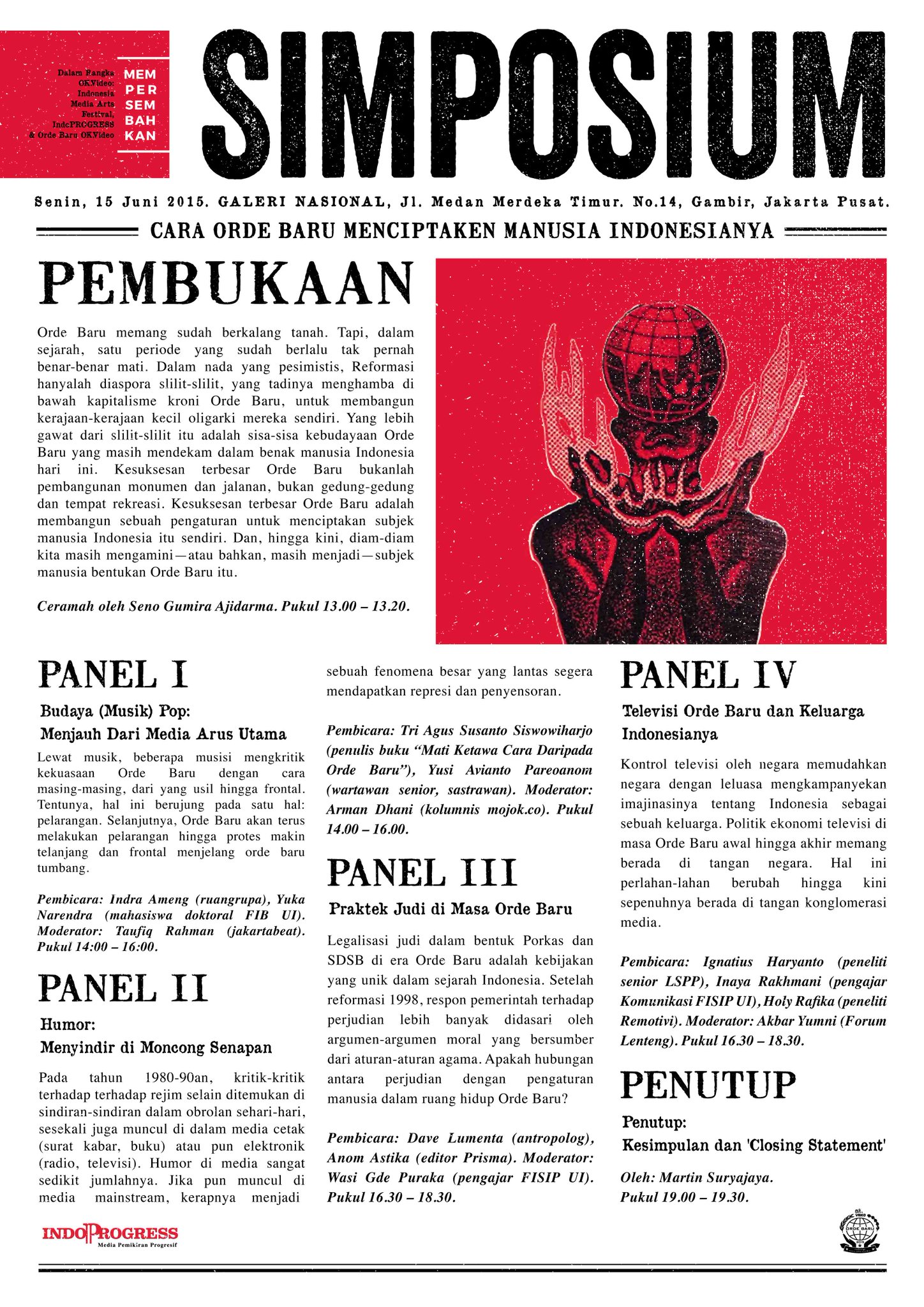
Keluarga Komersial (OK. Video)

Last Monday (15/6), I got the chance to exchange views with the crowd at OK Video, which was really enriching (not to mention a breath of much-needed fresh air outside of campus). I sat in a couple of panels, although I didn't manage to get more time off from the office. But all in all it was really fun, and I thought of sharing. 


Sources linked.

While I was reading up for the panel, I got a good chance to reflect on changing continuities from the authoritarian period (1965-1998) to today. Overlaps and contradictions came to mind, and it gave a moment to think about democratisation from a different light. It is very important to me, as a scholar and mother, to contemplate about how the memories of the previous generation mean for those, like my son, born after Reformasi. What kinds of authorities must he, and my students and I and we, stand up to and speak up against today. Lets not forget that in many times and instances, within ourselves.

Below is presentation slide (IND). Many thanks to RuangRupa and IndoProgress for bringing in at least one female speaker :P. 

Tuesday, May 06, 2014

Change Begins at Home

As part of my Indonesian civil servant recruitment (CPNS), I had to do a complete health check at a local State Hospital. I was ready to go through an inefficient, bureaucratic experience of a day (which was the reason why I had procrastinated for a year before actually doing it). To keep my sanity, I told myself to approach it as ethnographic research :p.

After being pointed to several mistaken desks, a hospital administrator directed me to the health check unit that takes care of CPNS like me. The lady in charge of the unit ticked some boxes after asking what ministry I was from. Then she put me in one group with several others who were also recruits like me.

We were lining up to get our blood drawn, and the lady put one folder on top of all our folders. "Yang ini diduluin ya, anaknya Pak Tono," she said, asking the laboratory officer to let the woman who came after all of us cut the line. The laboratory guy nodded.

I looked around for responses. Nothing. The five people before me did not feel that that was wrong.

I asked the whole room, including the woman whose back was to me, if that was alright. They were silent. "Jadi ngga apa ya, antrian kita diselak? Bapak, sistemnya gimana, ya?" I asked the guy what hell of a system he has. He took a deep breath, then asked me if one person cutting in would be okay. I asked back to the whole room. They said yes.

So apparently we have all agreed to let this happen.

As my order in the line came up, I hoped silently that they guy would not stab me with the needle repetitively (he didn't). Instead, he said softly to me that like me, he thinks it's unfair. "Siapa sih yang mau ya, Mba, membiarkan yang kaya begini. Tadi itu kerabat Direktur sini," revealing that the woman before was a relative of the unit's Director. I shared to him, as he was drawing my blood, that I was from UI. That like many bureaucracies, I have also experienced injustice, whether it directly or indirectly. "Tapi kan ngga bisa diam, Pak," I said. I asked what his name was, and saw his body tense up as he answered. I realised that he was afraid I would report him, when I had only meant to get to know a person, and let him know me as a person. The person he unwittingly wronged because he opted to avoid conflict.

I am not very sure how to process what had happened, aside from acknowledging the fact that power abuse is also permitted by us workers. That if we refused to be treated that way, it would not have happened. That being afraid we would get into trouble is not a reason to deprive others of what is rightfully theirs. We become just as responsible.

I also appeal to bureaucrats, despite handling 1,001 trinkets and facing frustratingly idiotic rules on a daily basis, to once in a while not delegate administrative tasks to our staff. By doing these things by ourselves, we are reminded of how we ourselves can inadvertantly participate in sustaining an inefficient system that could enable power abuse.

And, to me, it begins with little things. In our every day lives. Constantly, consistently, with practice.

If you're thinking of why we should do this, we are poorly paid and appreciated as it is. I'd like to share the opening of a book I was reading for a class (Mike Wayne [2003]):

For my son Jacob, because change begins at home.


Sunday, January 12, 2014

Let the Bubble Burst


"Don’t handicap your children by making their lives easy.”

Robert A. Heinlein

I first read that quote, or precisely retweeted it, from a dear friend of mine, Endah Triastuti (@dektitut). I began reading about the person saying it, Heinlein, a science fiction writer. The themes he raised in his work have been greatly about non-conformity, liberty, and self-reliance.

I write this post as a parent, as much as I am a child. And I will begin with how I see Jakarta’s upwardly mobile middle class society today, of which I am a part.

Let’s begin with where we live. We live in housing compounds, protected by 24-hour guards. We build fences around our homes, and have torrents to filter our water.

We take bank loans to buy private vehicles, because public transportation is so unreliable.

We are the world’s fourth largest communication technology user. We use it to maintain contact with people close to us rather than getting to know interesting strangers.

We use them to take pictures of ourselves, our children, what we eat. We share them with people who, in our minds, are closest to us.

We have irrational medicine use. At the first sign of flu, we take three types of medicine. We ask our doctors to give us antibiotics before giving time for our bodies to fight the viruses.

All of these are symptoms. That our environment has become so unsafe, we create a protective bubble around us.  

Now let us reflect on our children, and more abstract notions.

We vaccinate our children, in the largest sense of the word. We put them in schools that keep them away from harm. We hope that one day, if they know all the important things, these memories can be used as tools to fight off social illnesses.

In our consciousness, we see the world as a dirty, filthy place. And we try to keep our children clean.

How has that been working so far?

I see adults who never really mature. We were so afraid of infecting our children with diseases that they never really developed immunity. As adults, most don’t know exactly how to rely on themselves, and not objects around them, to mentally process life’s complexities.

And that’s why we have become such a consumerist society. Why malls are everywhere. We buy things; accumulate objects to keep our world safe and comfortable. From binging on food, collecting handbags and shoes, buying the newest gadgets without really using it to make our lives more efficient.

And how do we interact in non-consumerist spaces? Outside of malls. How do we interact online? We do it as consumers.

We collect likes from friends each time we upload a photo or a status. We collect friends. We group with those likeminded with us, and ‘other’ people who are too different from us. When the space has become too dirty, we move on to the next space. From Friendster (infected with alays), to Facebook (infected with distant relatives), to Twitter (infected with public personalities), to Path.

And at this point, we adults are in fact children who never really grew up. We are the ones ‘handicapped’, because we have had ourselves kept safe, we continue to keep our children’s world safe, and we come full circle to Heinlein’s quote.

This has been how we’ve been building our society for the past decades. A huge, safe bubble that is supported by objects to give a sense of comfort from an insecure, unreliable world. We have utterly weakened ourselves, and our children, in the process. How do we raise children to rely on themselves, if we ourselves have not?

I would rather not live in a bubble, than live with fear, thinking of how it might burst one day.

And perhaps, let it pop while it’s small.

Wednesday, November 27, 2013

Siapakah Sang ‘Imperialis’ Budaya?


Resensi Buku (Kompas, 24 November 2013, hlm 19)

Judul Buku: Countering MTV Influence in Indonesia and Malaysia
Penulis: Kalinga Seneviratne
Penerbit: ISEAS
Cetakan: I, 2012
Tebal: xxiii + 278 halaman
ISBN: 978-981-4345-23-1

Siapakah Sang ‘Imperialis’ Budaya?

OLEH INAYA RAKHMANI

Bagi warga perkotaan, hanya dengan melihat logo M kuning melengkung mungkin akan cepat mengasosiasikannya dengan gerai cepat saji McDonald’s. Jika melihat celana jins, akan teringat Levi’s. Globalisasi ekonomi telah mengantarkan produk-produk tersebut ke dalam kehidupan sehari-hari masyarakat urban di seluruh dunia.

Asosiasi logo dengan merk ini hanyalah pucuk gunung es dari struktur ekonomi global yang menopang kuasa Amerika Serikat atas negara-negara berkembang. Hal ini diyakini telah mencerabut penduduk negara konsumen dari akar budayanya. Beginilah lebih kurang gagasan imperialisme budaya yang didengungkan sejak tahun 1990-an.

Namun, buku Countering MTV Influence in Indonesia and memberikan bahan untuk mempertimbangkan kembali imperialisme budaya dengan mempelajari pengaruh MTV di Malaysia dan Indonesia. Seneviratne, penulis buku ini, menelusurinya dalam konteks musik irama nasyid (Malaysia) dan dangdut (Indonesia) yang justru naik pamor dari musik rural ke musik “bangsa” yang menurut penulis, semua terjadi karena telah beradaptasi dengan aspek-aspek MTV.

Sebelum menjelaskan tentang strategi bisnis MTV dan implikasinya terhadap budaya lokal, Seneviratne memaparkan terlebih dahulu eksistensi serta dinamika musik dangdut dan nasyid di negaranya masing-masing. Musik dangdut, misalnya, pernah berguna sebagai kendaraan politik demi menjangkau masyarakat pada akhir 1980-an (hlm 140). Pada 1995, Menteri Sekretaris Negara Moerdiono menyatakan bahwa dangdut amat “Indonesia” dan bahwa, seperti negara ini, dangdut adalah dari, oleh, dan untuk rakyat. Dangdut, yang tadinya dimainkan dari panggung ke panggung di daerah rural Jawa, disiarkan pula di TVRI. Di waktu yang sama, pemerintah Malaysia mempromosikan musik nasyid yang bersifat “Islami” dan juga Melayu, dengan mendukung pengorganisasian kontes nasyid di tingkat nasional serta menyiarkannya ke seluruh negara (hlm 55).

Setelah memaparkan hal ini, Seneviratne menjelaskan strategi MTV Asia ketika berekspansi dalam region Asia. MTV Asia bermaksud menjaring aspirasi kelas menengah muda untuk menjadi “keren dan modern” sekaligus menghindari risiko kegagalan bisnis dengan mengakui pijakan budaya mereka. Oleh karena itu dibuatlah MTV Syok (Malaysia) dan MTV Salam Dangdut (Indonesia).

Mempribumikan globalisasi

Keunikan dari kedua genre musik ini adalah bahwa di dalam liriknya, tidak terbaca adanya naratif dominan (hlm 55) yang mempermudah atribusi pesan-pesan lain. Karena itu, nasyid dan dangdut mampu beradaptasi dengan realitas sosial baru yang kini lebih melibatkan motivasi komersial media ketimbang kepentingan politik rezim tertentu.

Sebagai konsekuensi, ruang-ruang budaya baru yang dibentuk oleh MTV Asia justru menaikkan pamor musik yang kerap diasosiasikan dengan masyarakat kelas menengah ke bawah ini (hlm 78-79). Tentu hal ini terjadi berbarengan dengan semakin komersialnya musik nasyid dan dangdut melalui medium televisi masing-masing negara, sehingga sulit membuktikan klaim MTV Asia bahwa mereka adalah penentu dalam fenomena ini. Namun yang perlu digarisbawahi, saat MTV Asia memperoleh legitimasi bahwa merekalah yang mampu menentukan siapa yang “keren dan modern”, musik nasyid dan dangdut semakin relevan sebagai budaya populer karena kini juga memiliki nilai komersial. Hal ini memunculkan pertanyaan penting yang merupakan fokus studi Seneviratne: mempelajari dampak globalisasi dalam bentuk terpaan MTV di Indonesia dan Malaysia serta memikirkan ulang apakah benar imperialisme budaya sedang terjadi.

Kekhawatiran terbesar dari para pemikir imperialisme budaya dan mereka yang berjuang melawan pengaruh asing adalah bahwa masyarakat, terutama orang muda, tercerabut dari akar budaya lokalnya. Dalam konteks musik dangdut, melalui kasus goyang pinggul penyanyi dangdut Inul Daratista yang diprotes Rhoma Irama karena telah mencemari citra dangdut Islami yang ia bangun (hlm 190-208), Seneviratne mengajukan beberapa pertanyaan kritis. Bukankah goyang pinggul Inul yang menyertai musik dangdutnya bisa ditelusuri akarnya dalam tarian tradisional Jawa (hlm 234)? Bukankah popularitas dangdut yang terus meningkat membuktikan kalau justru budaya lokal menggunakan format modern, yang juga “format MTV”, untuk berkembang?

Ketimbang mengaitkan fenomena ini dengan “Westernisasi”, Seneviratne mengaitkannya dengan “modernisasi” (hlm 235). Tarian erotis Inul menuai protes bukan karena merupakan produk asing, tapi karena tidak sejalan dengan moralitas Islam masyarakat dominan yang juga merupakan alasan kenapa musik irama Malaysia dan nasyid begitu populer di negeri tetangga. Dengan argumen ini, penulis memosisikan baik Barat maupun Timur Tengah sebagai imperialis budaya karena budaya tradisional Jawa bagi penulis lebih cocok disebut sebagai akar budaya Indonesia. Ia menyebutnya sebagai “mempribumikan globalisasi” (indigenizing globalization), saat produk budaya lokal dikemas dengan cara modern, yang tidak hanya menghasilkan hibrida ekspresi budaya global dan lokal, tapi juga menjadikannya produk pribumi (hlm 248).

Satu hal yang mengganggu saya akan argumen Seneviratne adalah bahwa meskipun penulis meninjau konteks sejarah dan pengaruh budaya India, Cina, dan Arab dalam musik irama Malaysia, nasyid, dan dangdut, ia tidak berargumen bahwa percampuran ini juga adalah hasil globalisasi. Oleh karena itu, kesimpulan bahwa musik lokal adalah hasil dari “mempribumikan globalisasi” bagi saya kurang pas untuk menjelaskan kompleksitas pertarungan kepentingan yang bermanifestasi melalui ekspresi kebudayaan. Seluruh ekspresi kebudayaan yang tercatat dalam sejarah, termasuk apa yang tercatat dan apa yang tidak, adalah hasil kemenangan satu kelompok atas kelompok lainnya. Di sini, termasuk budaya tradisional Jawa yang disebut penulis sebagai akar budaya Indonesia. Oleh karena itu, buku Seneviratne membuka peluang bagi pemikiran baru yang mempertanyakan apa itu “akar budaya” Indonesia, apa manfaatnya, dan siapa yang menarik manfaat darinya.

INAYA RAKHMANI
Peneliti Kajian Media
Departemen Ilmu Komunikasi,
Universitas Indonesia


Saturday, July 13, 2013

A Pause


Yesterday was my son's, Malik, Kindergarten orientation day. As the teachers were presenting the semester outline to the parents, the children who were there started doing their own thing (like five year olds usually do). Malik's class mate Aisha (pseudonym) began drawing.

She had really clear strokes and was very detailed. She described to me that she was at her house. "Look at the roof!" she pointed to the lines of stacked roof tiles she drew one by one. Malik asked for a paper and pen as well. They began drawing next to each other.


Malik's drawings, as he often does at home, were explosive. There's a scenario that involves explosions and fire and fire engines spraying water to tend the damage. As usual, his hands moved as fast as his words. Aisha began looking at his drawing and asking questions.

"What's that?" "Why?" "How come?"

They talked to each other quite seriously and inaudibly, then Malik gave her the pen, "Would you like to draw?". With Aisha's detailed strokes on the paper, Malik's explosive drawing turned into something else. She drew a flower and a person and fishes in a pond. She returned the pen, Malik took it, they talked about what to draw next. They exchanged the pen for quite a while, equally, without guidance.

I was taken aback as I witnessed how these two young people collaborated so nicely. Neither was dominant in deciding what the drawing would be about, neither raised their voices, neither tried to outdo the other. They were just enjoying creating something else.


You would think I was romanticising children, I'm not. I have also witnessed children, including my own son, try to manipulate each other into lending them a toy or playing something they prefer. They are just as capable of complex emotions as adults. But this one moment, I was lucky enough to see something else.

They weren't guided by 'what one is supposed to do' because it's 'the right thing', 'berpahala', or anything moral. It simply felt natural to them. One thing that I rarely see in adults (and increasingly so of late).

There's usually an interest, an assessment, some variation of mild to extreme power play that would make us naive if we don't at least try to understand. And, if we're lucky enough, remember that understanding comes with subjectivity.

So I would just like to cherish this, and share, how these moments surround us. And if we walk slower and pause, seemingly mundane things can take our breath away. Kind of reminds us that it is the mundane, at times, that matter. The meaning we seek so rigorously outside, is not so far out of reach.

Saturday, March 02, 2013

Publikasi Ilmiah dan Solusi Jangka Pendek

A repost of my article in Kompas newspaper, 25 February 2013 on why Indonesian scholars are not writing; available online here.

Karena kurang optimalnya Surat Edaran Ditjen Dikti No 152/E/T/2012 yang mewajibkan doktor memublikasikan karya ilmiah, tahun ini kewajiban tersebut akan diperketat.

Strategi yang diambil Direktorat Jenderal Pendidikan Tinggi (Ditjen Dikti) secara teknis juga menarik. Demi meningkatkan kualitas jurnal ilmiah di Indonesia, Januari lalu, Dikti—bersama Lembaga Penelitian dan Pengembangan Masyarakat ITB— meluncurkan Indeks Sitasi Indonesia. Ke depan, diharapkan laman tersebut bisa menjadi basis data abstrak dan sitasi dalam skala nasional.

Membangun jejaring yang mampu mengakomodasi publikasi ilmiah dosen dan peneliti dalam negeri yang terpencar tentu merupakan langkah baik. Namun, di saat bersamaan, sebagai redaktur pelaksana jurnal ilmiah nasional, saya merasakan sendiri bagaimana budaya menulis ilmiah—yang didukung kajian literatur yang serius, data yang kuat, dan analisis yang mampu mengungkap bagaimana temuan akan bermanfaat bagi publik yang lebih luas—amat langka.

Ditjen Dikti dan ITB sebagai pelaksana teknis mengambil langkah progresif menggunakan perkembangan teknologi informasi untuk mengatasi permasalahan minimnya publikasi ilmiah dalam negeri. Tetapi, jika publikasi ilmiah yang berkualitas itu langka, apakah peningkatan jumlah sitasi artikel akan menghasilkan peningkatan kualitas keilmuannya?

Ketimbang mengungkap permasalahan struktural secara normatif, saya ingin menyampaikan bahwa minimnya publikasi ilmiah ini adalah kelalaian bersama. Permasalahan struktural ini dengan reflektif dijelaskan oleh para pengajar di Universitas Indonesia (Membangun di Atas Puing Integritas, 2012).

Permasalahan ekonomi-politik sistem pendidikan tinggi dalam negeri juga sudah menjadi pembahasan sejak 1990-an. Masalah ini makin kompleks sekitar tahun 2000-an. Dengan status Badan Hukum Milik Negara, di mana otonomi kampus dari segi keuangan ternyata tidak berkorelasi dengan peningkatan mutu pendidikan.

Berbicara dalam konteks perguruan tinggi negeri (PTN) tempat saya bekerja, banyak dosen yang tidak sempat menulis dan berkarya karena dibebankan enam mata kuliah (18 SKS) per semester (setara dengan 30-35 jam kerja per minggu) di luar memegang jabatan struktural (setara dengan posisi manajer dalam perusahaan, juga 30-35 jam kerja per minggu). Hal ini disebabkan perubahan status PTN yang memiliki implikasi sistem keuangan yang mempersulit para pemimpin departemen memproyeksikan berapa jumlah dosen baru yang perlu direkrut untuk mengatasi ketimpangan rasio dosen-mahasiswa.

Karena itu, yang diambil adalah solusi-solusi jangka pendek yang amat pragmatis. Sebutlah pemberian beban kerja berlebihan atau memberikan mata kuliah tidak sesuai keahlian akibat kurangnya dosen tetap.

Perihal peningkatan kualitas akademik, Dikti sebetulnya sudah berupaya mengembangkan kapasitas dosen dengan memberikan beasiswa doktoral untuk menempuh studi di luar negeri. Namun, karena permasalahan struktural tadi belum diatasi, ketika kembali ke Tanah Air para dosen ini kembali diberi beban mengajar yang berat, yang mempersulit mereka untuk berkarya.

Tidak ada peningkatan jumlah karya ilmiah sejak beasiswa tersebut tersedia karena permasalahan kurangnya sumber daya pengajar belum diatasi. Tak heran bila Indonesia tertinggal jauh dibandingkan negara-negara dalam regional yang sama (Evers, 2003). Sebagai ilustrasi, Singapura memiliki 94 jurnal internasional dan Malaysia memiliki 45 jurnal internasional, sementara Indonesia hanya memiliki 12 jurnal internasional.


Memikirkan solusi

Dengan mempertimbangkan kenyataan hambatan struktural, maka inisiatif Dikti melalui Indeks Sitasi Indonesia tidak akan membuahkan hasil signifikan. Begitu pula langkah Dikti membatasi beasiswa doktoral khusus untuk program studi yang menghasilkan publikasi di jurnal internasional. Permasalahannya, setiap program studi tidak mampu membangun lingkungan akademik yang sehat sehingga menghambat pengembangan kapasitas dosen dan penelitinya.

Oleh karena itu, jika obyektif, untuk meningkatkan kualitas penelitian dan publikasi ilmiah, yang pertama harus dilakukan bukan hanya menelurkan kebijakan dari atas, tapi juga identifikasi masalah di bawah: memahami akarnya dari realitas keseharian para pengajar.

Sebagai ilustrasi, ada satu jurnal internasional—yang tak jelas peninjau dan asal-usulnya—yang menawari dosen ”negara berkembang” memublikasi karyanya dengan biaya 1.000 dollar AS dengan mengirim surat elektronik secara serentak. Solusi laissez-faire macam ini muncul karena pihak-pihak tertentu mengidentifikasi adanya ”permintaan” yang tidak dibarengi kemampuan pihak yang terlibat untuk memenuhinya. Jika Dikti tak segera mengisi ruang vakum tersebut, kemungkinan solusi macam inilah yang akan diambil, seperti dilakukan begitu banyak sektor lain di negara kita.

Oleh karena itu, yang pertama harus dilakukan adalah memberikan pelatihan kepada staf pengajar untuk membangun budaya menulis akademik. Namun, karena peneliti senior dalam negeri yang memiliki publikasi yang diakui kolega internasional amat langka, akan kurang efektif jika pelatihan tersebut dijalankan secara in-house di tiap universitas. Konsekuensinya, pelatihan ini harus melibatkan akademisi Indonesia yang juga pegawai di sejumlah institusi pendidikan di negara seperti Australia, Belanda, dan Jepang, yang memiliki basis kajian Indonesia yang kuat.

Program Scheme for Academic Mobility 2013 (SAME) yang mendanai kerja sama antara institusi pendidikan dalam dan luar negeri bisa mengakomodasi pelatihan semacam ini. Jadi, sebetulnya pelatihan bisa direalisasikan dan dana sudah dialokasikan Dikti. Masalahnya, apakah setiap pihak yang terlibat mampu secara independen berjejaring untuk jadi bagian dari solusi.

Sunday, October 14, 2012

Present in Presence

To those living in cities with high usage of smartphones, this may be a common sight:

A group of friends, eating together, but busily typing on their phones. Taking pictures of each other, smiling to the small, built-in camera. Quickly going back to their phones, posting the pictures on the social media space they're part of. Twitter, Facebook, Tumblr, Instagram, Path. They would periodically check their phones, sometimes typing away as their friend is talking - half listening, half nodding, half-everything.

Now. Think about billboards. As we're stuck in traffic, how much waste of unnecessary advertising blinking before our eyes. Some billboards are even moving images. Products we don't need, lifestyles that don't make us any happier or fulfilled. We train ourselves to ignore them, block out noise. We desensitise ourselves.

This noise block reminds me of putting on headphones to block out car honks and people yelling. It reminds me of scrolling down my Twitter timelines, feeling claustrophobic reading dozens of people reporting what they're eating, where they are, replying to mentions with 'OK'. Like ignoring commercial during TV breaks.

Our attention span becomes shorter, easily diverted because if we don't train ourselves to block out noise, we would be overwhelmed with unusable information (how does one respond to a headline saying 'Bieber publicist: Stolen laptop tweet not hoax' that is mentally healthier than self-induced amnesia?). This poor attention span relates to that friend typing away on their smartphone a second after they asked how we are, nodding away while they give us half-attention over our half-explanation.

It made me think about the notion of 'present'. And this is when I give you my disclaimer of 'bear with me now I will soon go into a very boring monologue'.

'Western' civilisation has taught us with the concept of linear time. Past, present, future. There's a desire of fixity, of predictability. Hearing 'Can we meet on 6 pm' is so much more reliable than 'Meet around Magrib?'. Our activities become planned according to our predictions of what will happen in the future. From our television news programmes to our 10-year career plans and our children's education. Anything else that doesn't fall into that fixity, we block out. Like commercials, like billboards, like trivial Tweets.

Compare this with the Inuits who centre their lives around activities, particularly hunting. A father teaches his son on patience while waiting for a prey to come, for nature always gives as needed. They hunt as they need to survive and do not believe in accumulation and savings. Consequently, the notion of greed is void in such culture. It is considered offensive to ask 'May I have a glass of water' to an Inuit. They do not see food as property. It is no one's. Everyone's. The winnings of a hunt, for instance, is not the property of the hunter - it is shared throughout the community. No half-attention span, no greed, no accumulation of property to be happy and secure.

Sounds like a good life, eh?

I then reflected on how my own smartphone, my own noise-blocking, my own concept of time and 'present' have left impressions on my mind and mentality. Have I ever checked my phone as my son was calling me? Yes. Have I ever interacted superficially with strangers on Twitter? Yes. Have I ever sat on a table during dinner and participated in an interaction where everyone was typing on their smartphones? Also yes.

It isn't about (negative) technological determinism. Some of my most meaningful friendships were cultivated through long distance communication. Mediated interaction does not always mean meaningless exchanges. It is about being present or listening, not about timeliness. Answering instantly.

It is about when we are relating to another human being, a friend, our children, our loved ones, we are in that moment - not blocking out a single thing. Our whole being, is being there. 

It is something we sense when we read a book to our children and kiss the top of their heads. It is the sense we get when reading that long email we received from an old friend living abroad. Or when we shut our phones off before the plane takes off, close our eyes, and enjoy that moment of utter silence.

It is about feeling and being. 

And I realise, now, more than ever, how we have let the overabundance of information and the multiple features made available by technology take that away from us.

So I have uninstalled all of the social media applications from my own smartphone. I have stopped my push emails, so that I don't read a work-related email on a Saturday during lunch with family. When I am ready and focused, I check my emails and respond to my colleagues (and sometimes also during a weekend, as I also sometimes have a family day on a workday!). 

It's isn't about the technology or the mediated space of social media. But doing it when we choose to, not just because it arrives on our doorstep. Interacting when we know we can read properly and not half-critically respond just for the sake of instantaneity (this noun does exist! Check Merriam-Webster).

It reminds me a bit of Fromm's 'freedom from' and 'freedom to (Escape from Freedom, 1941). For Fromm, 'freedom from' (I think there are some parallels with 'escaping') is to free oneself from social conventions. Like an oppressed Catholic student who turned into a liberal feminist, or the exact opposite, a born-again Muslim turning to religion because of culture shock living in a 'Western' country. It becomes a kind of 'religious conversion' or jumping ships, being scared and finding sanctum. I don't think moderating information exposure is about running away from social conventions. About leaving mediated social interactions or not accessing information. It's about 'freedom to'. To decide for ourselves what kind of person we would like to be, what makes us whole and content. And in that, it includes some features of the 'thing we were 'running from'' (pardon the multiple quotes). I choose to be present in presence. And in that, I will choose what information I invite into my own mind, and I do not escape information altogether.

I may disagree with her policies, but this quote by Margaret Thatcher is pristine (in my defence, I see Meryl Streep mouthing it in the Iron Lady):

Watch your thoughts for they become words. 
Watch your words for they become actions. 
Watch your actions for they become habits. 
Watch your habits, for they become your character. 
And watch your character, for it becomes your destiny! 
What we think we become.

Have a happy Sunday! Toodles.

Saturday, April 07, 2012

On Soulmate(s)

There are many views on soulmates. Plato, in the Symposium, told the story of how Zeus, fearing the power of humans, split them in two - making them spend their entire lives searching for the other half. In Abrahamic religions, soulmates are generally believed to be predestined, one for each, and kept by building marriages to maintain order and fairness. Postmodern views on soulmates break them into several people; releasing love from institutional binds and allowing law to protect the vulnerable.

All the while Hollywood cashes in on our insecurities and dreams of finding the perfect person. Titanic grossed $1,851,561,750. I rest my case.

But I refuse to reduce the concept of soulmates into one person. The definition of mate is 'one of a matched pair'. It assumes that a soul has a form. I do not see souls, by definition an 'immaterial essence', as something that can be matched. Wong ngga ada bentuknya, gimana caranya ada pasangannya.

I cannot seem to stop citing on Erich Fromm's Having and Being; that in a post-industrial society we are designed to see people as objects. We forget that life is about experiencing and learning, not about possessing. By this assumption, soulmates are not to be attained, but to be experienced.

And what is experience if not present in various entities. I define soulmate(s) then as a soul's companion or entities through which we find meaningful experiences.

It may come through objects, like being inspired by a painting.
It may come from activities, like praying or hugging.
It may come from places, like when we take a deep breath after seeing a breathtaking view.
It may come from life periods, defining moments in our lives - a childhood memory.
And it may come from people. From our children, partners, meaningful friendships, and a genuine moment with a stranger.


They may be simultaneous, isolated, individual, collective, separate, intact; but they have one thing in common. In their meaningfulness, they contribute to our wholeness. And in that, they accompany our souls in the only way I relate to: that they are not ours to possess.

But a means to realise that we are living.

Sunday, December 11, 2011

Collective Moderation and Online Discussions

When I was an undergrad student, I dabbled in debating. Having little passion in competition (pardon me), I didn't really embrace the art. But I've always enjoyed following the structure of logical arguments that each debater performed. Although I personally think that it is more relevant to build a mentality of discussing and opening minds rather than the concept of winning and losing that is central in debating; I understood how important it is to have interest in global, national and local social issues and to have the ability to build arguments. One interesting thing about debating is how a debater would have to be able to switch from pro to contra as assigned by the panel. Their own ideological bias moderated by attempting to understand the argument behind an opposing view. It is a tolerance shaped by logical thinking.

I have been quietly observing online debates for the past year, both public and communal. And I realise that some of the most heated discussions are shaped around the logics of debating. Public discourses are reduced and polarised to winning and losing, pros and cons. And what is even more amusing, often not following the most basic rationales.

First, discussions sway from one topic to the other. If the original topic was, for instance, sexual harassment against females in the workplace, it shifts into a battle of the sexes. That women also objectify men and that the displaying of six packs on the cover of magazines is an example. But weren't we talking about sexual harassment in the first place?

Secondly, instead of focusing on the topic at hand, there are many comments on who the person speaking is. Whether or not they have credibility in what they say. Perhaps it is relevant to emphasise on that if it were a television talk show - because the person was presumably invited for their expert opinion. But online discussions are virtually anonymous. Users can have multiple accounts, pseudonyms or simply display a persona. It becomes irrelevant to pinpoint on whether or not someone has the 'right to say so'. For a discussion to remain focused, it needs to be centred on the substance of the arguments and disregard the background of the speaker.

Thirdly, there are a lot of anger displayed through USING CAPSLOCK and name-calling; which could easily turn into a fight. I have read emails sent by a 50 year old religious public figure calling their 'debating sparing partner' anjing (dog, which is perhaps as malicious as bastard in English). And of course, the discussion soon turned pointless.

Online interactions shape the characteristics of the public sphere and different online spaces, with its own features, contribute to this dynamic. In mailing lists, for instance, the moderator has authority to, well, actually moderate and keep the discussion healthy. In Facebook statuses, the owner of the wall has that authority. In Twitter, it's more libertarian than egalitarian. Users determine collectively how the discussion is carried out and no authoritative figure would step in if it stirred out of focus.

It needs to be a group effort, to maintain a discussion to be as healthy and interactive as possible. It's more beautiful if successful, as it was based on an authoritative-free, 'natural' interaction, and uglier if unsuccessful. I realise in several occurences that the discussion eventually enforced the ideological bias of a person once they're validated by someone like-minded. The initial assumption that online spaces could provide a space for different, even opposing, views to interact and shape a miniature civil society (I am rolling my eyes as I write this, you're not the only one) becomes obsolete. In reality, what's shaped are sub ingroups within the information elites (a penetration level of 22.4% of internet users in Indonesia that are centred on large, predominantely Java and Sumatra cities (MarkPlus 2011)), that, unfortunately, often become the source of news topics in the country's institutional media (e.g. television).

I'd vouch for more responsibility in respect to internet users, but I feel it's both senseless and useless. But here it goes: Indonesian internet users, please realise that what we have to say and the manner in which we collectively moderate online discussions do have offline implications. And as conscious citizens, it's our duty to practice tolerance in all spaces. Since it's very easy for us to exercise freedom of expression, it is only responsible to do it to open our minds and, if respecting is too ideal, to tolerate different views. When an idea is negated, it's because it's not rational - not because it's 'wrong'. Most of the time it's not the polarisations - conservative vs. liberal, patriarchy vs. feminism, religion vs. atheism, the list goes on - it's the grey space in between where we try to find out, for our own individual reflection, a subjective version of truth.

And it can only be done with a clear, unassuming mind.

Monday, November 14, 2011

On Why There Are Few Indonesians in Indonesian Studies

"Sekarang ini 90 persen publikasi dalam jurnal akademis tentang Indonesia ditulis bukan oleh orang yang tinggal di Indonesia. Hal ini, menurut Indonesianis Anthony Reid, menjadikan Indonesia negara yang paling tidak efektif menceritakan dirinya sendiri kepada dunia. Satu ironi yang perlu diubah." (Tempo, 14-20 November 2011)

This week's Tempo was exceptional for me. The magazine mapped out foreign scholars studying Indonesia - from Kahin, Anderson, Crouch, Hill and monumental works in Indonesian studies. I share the position Tempo's taken in elaborating the phenomenon that has been going on for decades (which, unfortunately, will not change in the near future). Ariel Heryanto's article in the same magazine elaborates very articulately, as he always does, the main problems in why there is a void of Indonesians in Indonesian studies. It has been his concern for a while.

I started off as an academic with naive optimism that agency could work. That if I strategise smart enough and be persistent enough, it could work. I am beginning to realise that this is not the case. It is practically structurally impossible for Indonesian scholars based in Indonesia to be academically productive. The rule in UI, for instance, is for teaching lecturers to be in charge of 2 to 6 classes per semester. Because of a lack of competent lecturers (why would an international graduate become a state official if they could get a job at a Multinational Corporation? That was sarcasm, in case it wasn't clear enough), some of the same lecturers who teach 6 classes also hold a structural position in which they would have to manage a programme with hundreds of students.

How on earth could someone, with a 9 to 5 managerial job, prepare materials for class - let alone read and write for a national and international journal? Let alone travel to other parts of Indonesia and/or the world to present papers? To even conduct proper research.

These seemingly casuistic events are systemic. All over the country, state academics face these problems. Syllabuses don't change from year to year, the same materials are used to teach students who are better off reading Wikipedia.

It's also ideologically impossible. Some of the most intelligent Indonesian social scientists I know have openly claimed that being solely an academic, writing and researching for a living, is not enough. "You need to be part of the struggle," one said, "There are too many issues to fight for, I don't want to spend my time writing and leaving no real impact." So some of the best thinkers join activism.

Again, I do share the sentiment of being part of grassroot changes - but when it comes to 'menceritakan dirinya kepada dunia', it is clearly ineffective. Ideas are not recorded into writing and are thus untraceable historically. There are lots of scattered media articles written by Indonesian intellectuals but very few are compiled into a book that can be cited as the basis of national policy making - let alone as part of an international narrative. I'm not being a local orientalist when I say this, because I'd also like to emphasise on a lack of an Indonesian perspective in international policy making. Bilateral and multilateral agreements as well as global non-profit strategies related to Indonesia are based on US, Western European and Australian researches.

I admire foreign scholars and Indonesianists, heck my supervisor is David Hill. I also find people from other nationalities very genuine in their writing and consistent when choosing anthropological approaches. But emerging Indonesians are not Indonesian (and I mean that in the least xenophobic way possible). There needs to be a degree of subjectivity in story telling to deliver authenticity. The experiencing of everyday Indonesian and local (ethnic) culture to acknowledge real problems worth writing about.

It is not about where we were born, but where we are predominantly based - and it influences the way we write and the topics we choose.

If the state and those in positions to determine changes on a macro and meso level do not support scholars based in Indonesia - either we will eventually move to a place where we can afford to write or people who come from other nationalities will write for us. Local and national researches will continue to be scarce and our theories and frameworks will continue to be Western. Sadly, I think Reid's and Heryanto's concerns are true and seemingly unchangeable for a while.

But I cannot (yet) let go of that naive optimism that somehow, with persistent agency, something's bound to work.

Wednesday, October 19, 2011

That of Jayapura

Once again, as part of my PhD thesis, I travel to another part of Indonesia: Jayapura, Papua. After completing data collection at SMAN 4 Jayapura, the vice principal asked me to fill in one of the ‘affirmative classes’ (i.e. classes designed for indigenous Papuans, funded by the local government under the special autonomy law). I had expected them to be particularly intelligent, being students of a prominent school. But I was still flabbergasted by how critical and brazen they are with the questions they addressed me with.

They asked me why I decided to go to Papua as part of my research. Usually any kind of development and/or research stops as Sulawesi.

They asked me what I expected of them before I arrived. Did I expect them to wear Kotekas like most Javanese do.

They asked of my thoughts on the Free Papua Movement. I answered as honestly that I could. That although I have an Indonesian bias, I was not born and raised in a land that is abused by foreign companies. The best I can do is support the right for Papuans to choose.

They asked me how old I was and why I decided to continue my education. They asked me how they can do the same and whether or not their being poor would hinder their efforts.

They asked me what my religion and ethnicity was. And with the chance to state my views prior to their questions, I understood from their gestures that having heard my answers – it did not matter to them.

I explained that it is very easy for people from Jakarta in particular and Java in general to compete. With sound infrastructure, the starting line of this sprint race is not the same. I also explained that there is increasing attention from international aid, in the form of scholarships, for East Indonesia. Do not stop.

If any of my students are reading this now, please realise that the competition is not fair. And it will remain unfair for quite a while. This sounds like a cliché, but while we fuss about not being able to watch Hollywood films during the weekends, some walk down mountains without shoes to receive basic education. It is the responsibility of the priviledged, because we were born in a social setting that makes it easier for us to be economically and socially mobile, to make sure we do what we can to make sure that nobody gets left behind.

Travel. Expose ourselves to less developed areas of the country (or the world). Choose a career line that is of benefit to other people. Living solely for our own happiness will sooner or later feel hollow and purposeless. At least for me.

It is not thoughtful, it is not even kind. It is being responsible; a lame attempt to avoid being ignorant. The cycle of inequality may only stop when we realise that it’s there.

And not keep quiet.